Assessment of the food waste regulations in EU countries thanks to a dedicated methodology developed in WASTEWISE
The WASTEWISE partners from Espigoladors have led a policy analysis of the National Regulatory Frameworks for food waste in Europe. Together with other research partners in the consortium, they conducted a systematic mapping and assessment of European-level policies —regulations, treaties, directives, and other non-binding instruments—across thematic areas potentially linked to the prevention and reduction of food loss and waste.
For the accomplishment of this objective, they developed a dedicated methodological framework inspired by the recent OECD report (2025) to characterise FLW policies, and assess both their direct and indirect relevance to FLW. Within this framework, an analytical tool was developed to systematically assess the degree of interrelation and alignment between FLW policies and other policy domains—particularly climate change mitigation and energy efficiency.
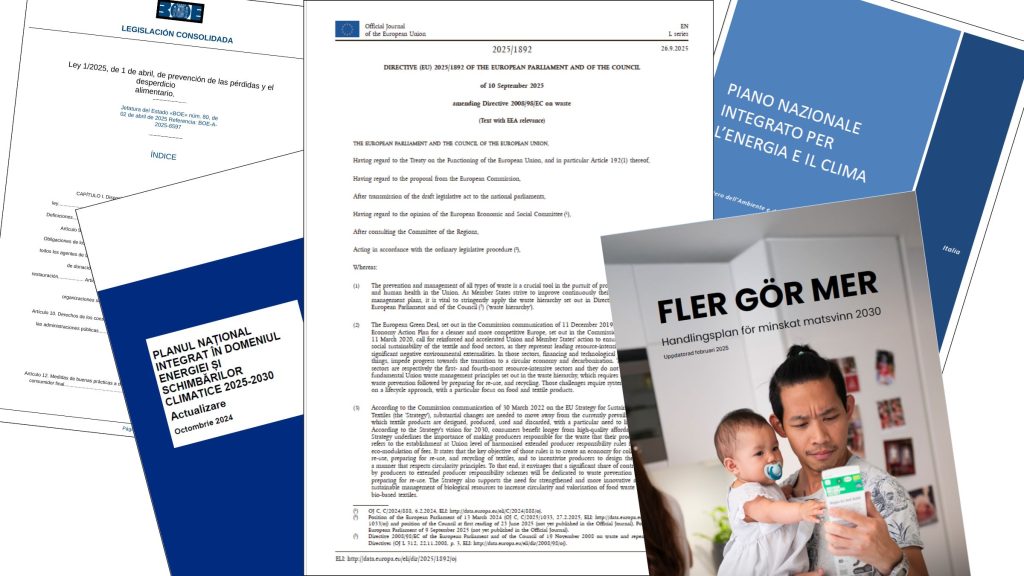
Since 2018, the European Union has progressively reinforced its framework on FLW. Subsequent measures bind member states to quantify and report food waste generated, as well as to include environmental criteria in their regulations. The EU has also set binding food waste reduction targets for Member States of 10% at the processing and manufacturing stage and 30% (per capita) at retail and consumption by 2030, based on the annual average of 2021–2023.
The WASTEWISE research team focused primarily on the consortium countries, and they observed that national transpositions of EU directives related to food waste vary in ambition among countries. Spain, Italy, and Romania have adopted specific national laws on FLW prevention and reduction, while Sweden, Finland and Switzerland rely on strategies and action plans. However, when examining their nationally initiated laws, variations emerge for instance in both the definition of food loss and waste and the corresponding reduction targets. These discrepancies create a lack of coherence between the transpositions of the directive and national policies, hindering the establishment of a unified approach to FLW management.
Overall, the analysis reveals that FLW prevention remains underutilised as a climate policy lever. Embedding it more systematically into climate, energy, and agricultural frameworks across the EU and Member States would unlock significant co-benefits for emissions reduction, resource efficiency, and food system resilience.