The rebound effect is often overlooked in life cycle assessments
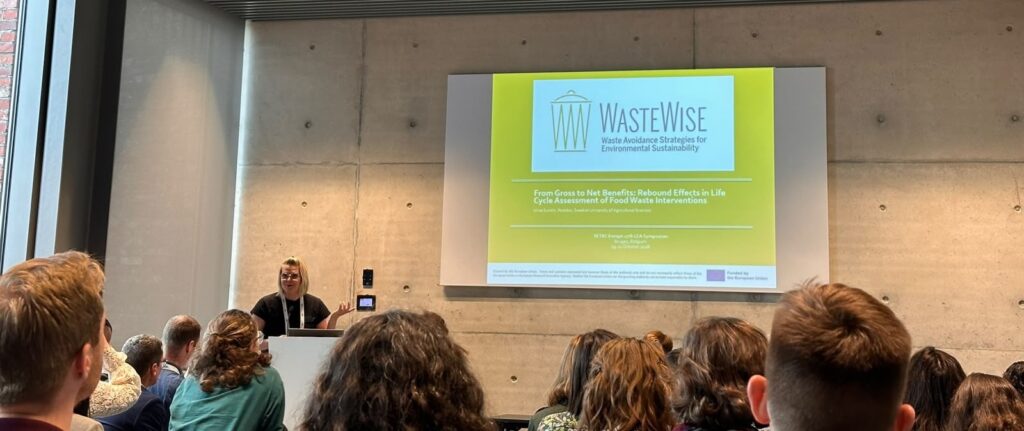
On 20 October 2026, the WASTEWISE partner Niina Sundin (SLU) participated in the SETAC Europe 27th LCA Symposium, held in Bruges, Belgium. As part of the session titled “Quantifying what we avoid: LCA for evaluating waste prevention and reuse”, she presented the results of the recent study investigating how life cycle assessment (LCA) practitioners consider rebound effects in LCAs of food waste interventions.
The study, based on a survey of LCA practitioners (n=79), found that although rebound effects are generally recognised as relevant, they are rarely included in quantitative assessments. Key barriers included limited data, methodological uncertainty and a lack of standardised approaches, even though similarly uncertain assumptions about avoided production are routinely applied.
Previous studies of surplus food redistribution (food bag donations and soup kitchens) revealed that re-spending of household monetary savings offset a substantial share of the expected climate gains (31% and 64%, respectively). Though the studied interventions remained net-beneficial overall, these findings demonstrate that gross estimates can significantly overstate environmental benefits when rebound effects are excluded.