Looking beyond food waste: the nutritional value lost across European supply chains
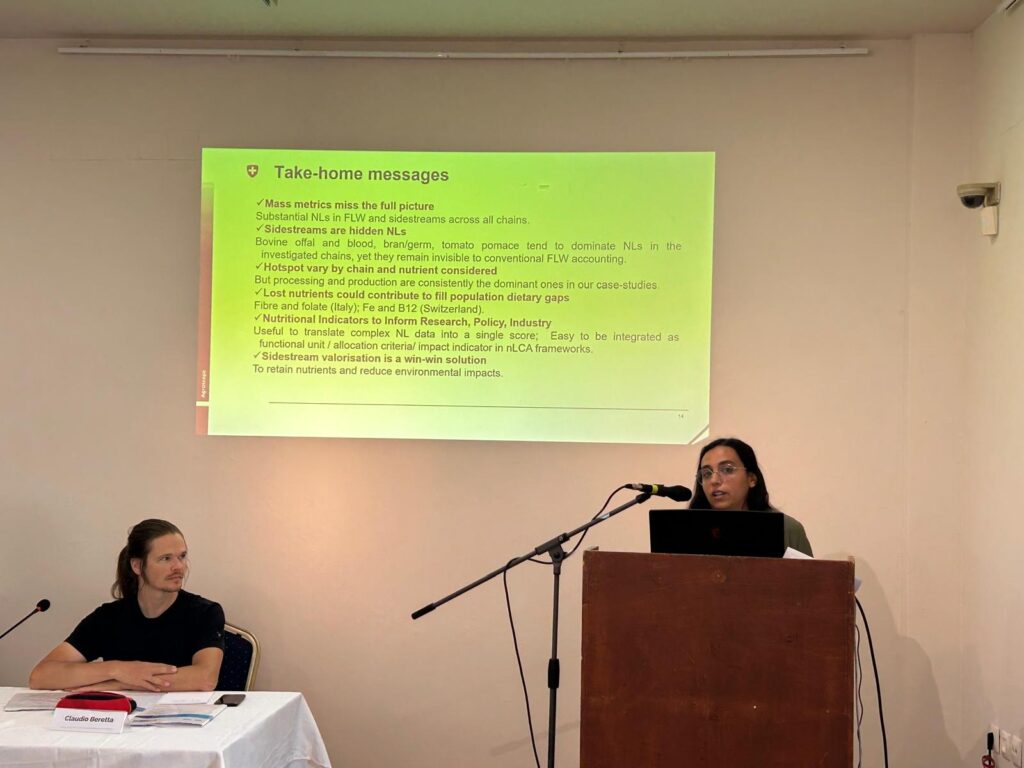
Food loss and waste (FLW) represent more than discarded food: they also mean the loss of essential nutrients that could contribute to food security. At RETASTE 2026 in Crete, Silvia Zingale from Agroscope presented research developed in WASTEWISE, proposing a nutritional life cycle assessment (nLCA) framework to integrate nutritional losses into environmental impact assessments and better understand the full consequences of food loss, waste and processing sidestreams.
The framework combines Material Flow Analysis with food composition data to quantify the loss of macro- and micronutrients across three European food supply chains: tomatoes in Italy, bread, pasta and pastry in Italy, and bovine meat in Switzerland. It also recommends broader system boundaries, nutritional adequacy indicators and approaches to assess trade-offs between nutritional and environmental performance, helping researchers identify where the greatest losses occur and where improvements could have the most impact.
The findings reveal the significant nutritional value that can be lost throughout food supply chains. In the tomato chain, food loss, waste and pomace contain enough vitamin A to meet 87% of the Italian population’s daily requirements. In the cereal chain, milling sidestreams and grain diverted to non-food uses result in losses exceeding the Italian population’s requirements for several nutrients, including dietary fibre, magnesium and iron. Meanwhile, offal and blood sidestreams from bovine meat processing could cover around 27% of Switzerland’s vitamin B12 requirements and 16% of its iron requirements.
Across the three supply chains, production and processing consistently emerged as major hotspots for nutritional losses, while sidestreams often contained more nutrients than food waste itself. The research highlights the importance of accounting for multiple nutrients and overlooked material flows when assessing food system sustainability. Preventing food loss and waste and redirecting nutrient-rich sidestreams towards human consumption could deliver benefits for both nutrition and the environment.