WASTEWISE presents its latest food waste monitoring study to the European Commission
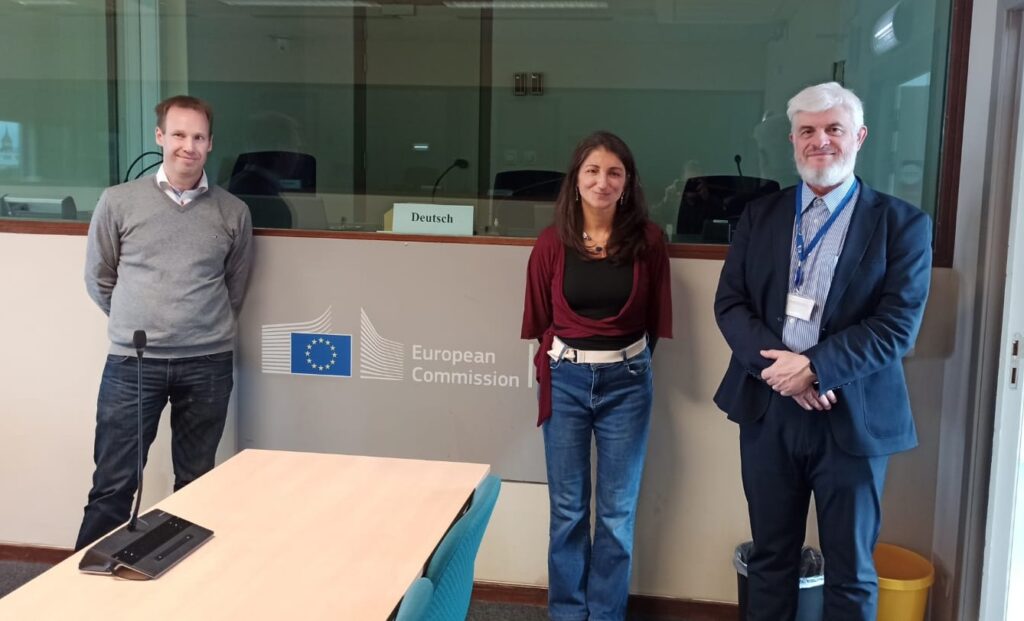
On 21 October 2026, a WASTEWISE delegation travelled to Brussels to meet with the European Commission’s sub-group on food loss and waste monitoring (see the agenda and presentation). Claudia Giordano (LUKE) and Mattias Eriksson (SLU) presented the project’s latest publication “Behind the data: An assessment of food waste monitoring in the European Union”. Héctor Barco, from Espigoladors, also attended to present the Food Loss Quantification Manual: Practical Application for the EU and Beyond, which was conducted within the sister project FOLOU. This meeting was an important milestone for WASTEWISE, as it provided an opportunity to present the project’s research directly to the Commission’s experts.
The WASTEWISE presentation formed part of a wider exchange on food loss and waste monitoring within the EU Platform on Food Losses and Food Waste. The meeting brought together contributions on measurement guidelines, monitoring tools, food loss quantification in primary production and the comparability of food waste statistics. WASTEWISE had a dedicated session to present its review of food waste quantification in the EU, providing an opportunity to discuss the study’s findings in detail with the sub-group and place them in the context of ongoing European monitoring efforts.
Based on an assessment of food waste monitoring for the 2022 reporting year across the EU-27, Norway and Iceland, the WASTEWISE study identifies significant differences in national methodologies and gaps in the documentation needed to assess how estimates are calculated. The research highlights the need for greater transparency regarding data sources, sampling procedures, scaling methods and uncertainty estimates. One of the most important aspects highlighted in the study is that such challenges matter because changes in reported food waste quantities may not necessarily reflect actual reductions, as they could result from changes in measurement methods. Improving the consistency and reliability of monitoring is therefore essential for evaluating progress towards European targets. The project will now begin work on identifying ways to improve the current reporting of food waste by EU Member States and to better translate the existing results into an assessment of the associated environmental and nutritional impacts..
Through the work completed and planned in WP1 and WP4, WASTEWISE will hopefully contribute to the research that has informed the European Commission’s approach to food waste quantification and reduction over time. This work builds on FUSIONS, which provided early operational guidance on quantifying food waste at national level, and subsequent EU-funded projects such as FOLOU and LOWINFOOD have further developed evidence and guidance on measurement and reduction. The continuity of research funding is encouraging, as it contributes to scientific debate and policy development, and is a clear sign of the beneficial impact of research on society.